Reading your DiscoAds reporting
Your reporting shows what DiscoAds is driving — impressions, clicks, and conversions — and lets you see performance over time. This guide covers where to find it and how to read the numbers.
Where your reporting lives
Reporting lives under Reporting & Insights in the left-hand nav. The Overview tab shows your key metrics — Ad Spend, Impressions, Clicks, Conversions, CTR, CVR, CPA, and CPC — with an over-time chart beneath; the Performance tab goes deeper, and Glossary defines every metric in place.
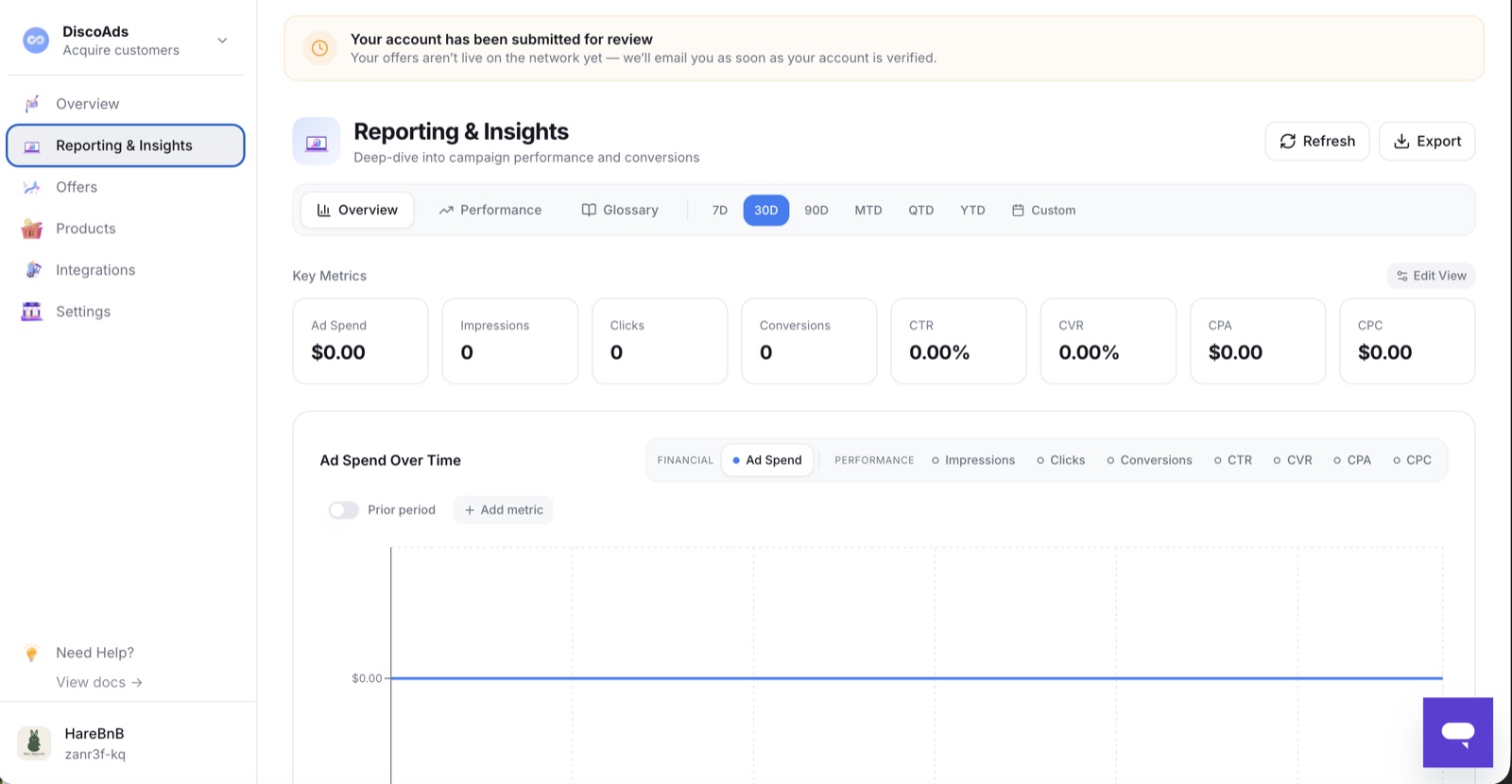
You can set date ranges (7D through YTD, or custom), compare to the prior period, choose which metrics display with Edit View, and Export the data.
Metrics glossary
What each metric means and how it's calculated:
- Ad Spend — the total amount spent delivering your ads across publishers in the selected date range.
- Impressions — the number of times your ads were displayed to shoppers across publisher surfaces.
- Clicks — the number of times shoppers clicked your ads.
- Conversions — completed purchases attributed to your ads, including view-through conversions that occurred without a preceding click.
- CTR — click-through rate: clicks as a share of impressions (Clicks ÷ Impressions).
- CVR — conversion rate: conversions as a share of clicks (Conversions ÷ Clicks).
- CPA — cost per acquisition: the average ad spend for each conversion (Ad Spend ÷ Conversions).
- CPC — cost per click: the average ad spend for each click (Ad Spend ÷ Clicks).
Attribution window
If you are on CPA/CPO bidding, a conversion is any purchase made within your attribution window after a shopper clicks or views your offer. By default, this is set at 14 days for clicks and 14 days for views. If you'd like a different window, contact your Disco team or submit a help request and we'll update it for your account. For more, see Disco's attribution model.
Reading early performance
New campaigns go through a short learning period while the model calibrates. Expect early numbers to move around, and give changes a few days before drawing conclusions. If results are soft, start with copy — see Improving creative performance.